There are events you attend. There are events you organize. And then there are those rare events that, somewhere between the sleepless nights, endless messages, last-minute changes, laughter, pressure, exhaustion and determination, become something much bigger.
They become part of history.
On July 25, 2026, along the beautiful Rhine in Rüdesheim am Rhein, a vision that had existed for months in conversations, meetings, spreadsheets and countless messages finally stepped into the open air.
The SAGO Music & Culture Festival 2026 brought Filipino, German and multicultural communities together through music, dance, food, culture and community — turning one summer day in the Rheingau into a celebration shared by thousands.
For me, however, this is a difficult story to tell simply as a journalist.
As Heyz Dela Cruz of What's Ganap and TTPM ACT Media, I can tell you what happened onstage.
But as Festival & Project Head and main organizer, I also know what happened before there was a stage.
I saw the meetings, the changes and the problems the audience would never know existed. I saw exhausted people continue working because something still needed to be carried, cleaned, decorated, coordinated or solved. I saw volunteers step into jobs that were never written beside their names.
And when the last guests had gone home, I saw the other side of the celebration too.
So this story is not simply about what happened on July 25.
It is about the people who made July 25 possible.
Before the Crowd Came, There Was a Vision
Every festival begins somewhere.
This one began with a vision from Besfrentofi, known to many as BFT, founder of SAGO International Club e.V. and TTPM ACT, and Festival Director of the SAGO Music & Culture Festival 2026.
Before the crowds, the performances, the food stalls and the flags, there was a simple but ambitious idea:
What if we created a music and culture festival here in Germany where Filipino culture could stand proudly beside German and other international cultures — not hidden inside a hall, but out in the open, for everyone to see, hear, taste and experience?
BFT believed it could happen.
The idea became a project. The project became months of work.
And eventually, it became a festival.
SAGO Music & Culture Festival 2026 was presented by SAGO International Club e.V. of Rheingau-Taunus-Kreis, in cooperation with Brömserburg am Rhein, and organized by SAGO International Club e.V. and Streamlining Ventures Events & Music Services, which also served as a major sponsor.
But behind every organization named on a poster were real people doing very real work.
The Work Nobody Sees
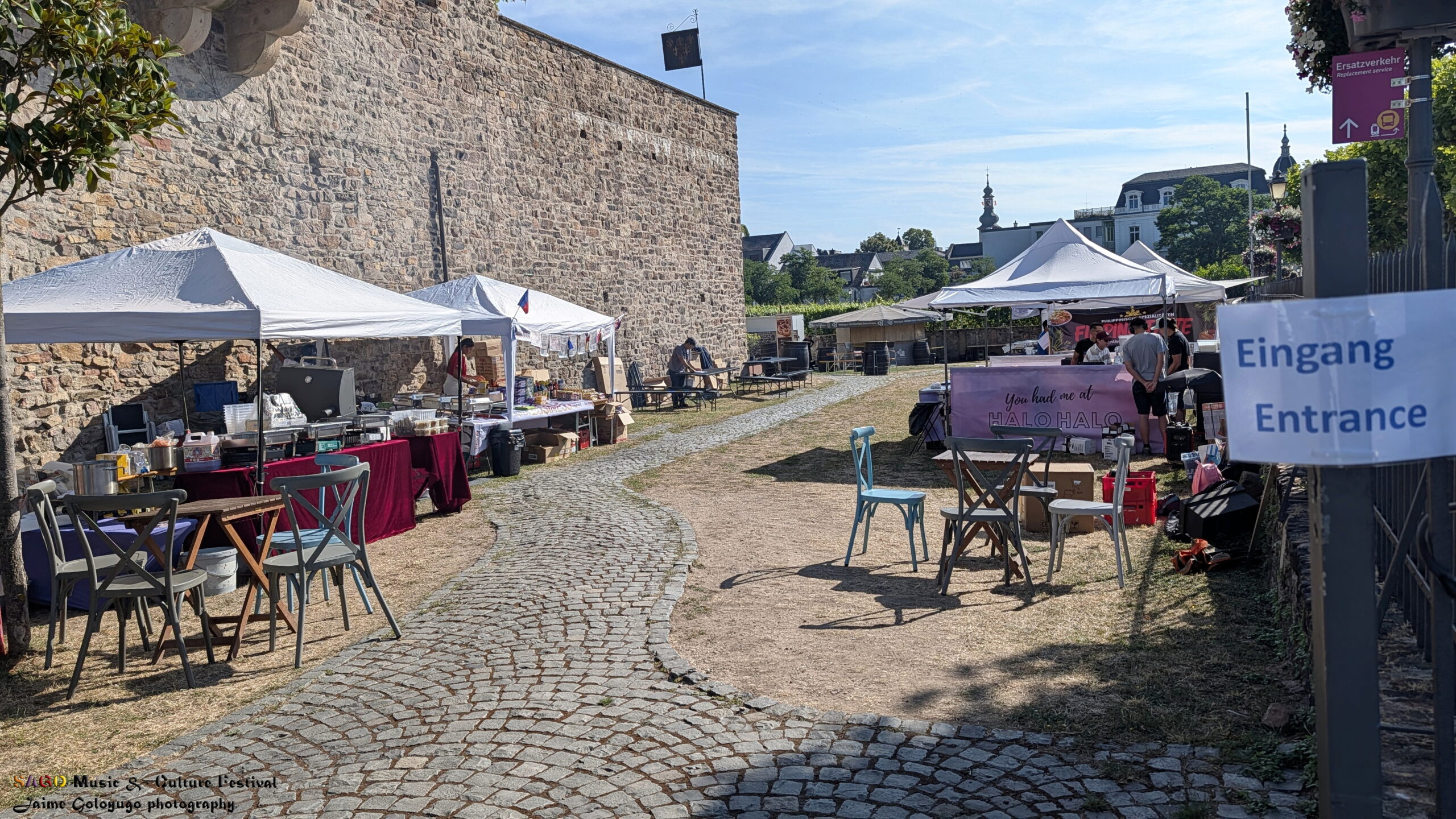
A festival does not magically appear when the gates open.
Before an audience hears the first song, someone has already answered hundreds of messages, spoken with vendors, coordinated performers, checked logistics, worked on safety, planned the program, approached sponsors, arranged media coverage and worried about all the details most guests will never need to think about.
And when one problem is solved, another usually appears.
Our core organizational team carried enormous responsibilities:
Behind those titles were meetings, calls, messages, revisions, lists, more lists, checking and rechecking.
From security and safety to first aid, stage management, sound, logistics, vendors, food, tombola, decoration, program coordination and guest assistance, every part mattered.
Because a successful festival is not created only by the person holding the microphone.
It is created by the people holding everything together.
And Then July 25 Arrived
Rüdesheim woke up that Saturday perhaps not yet knowing what was about to happen.
Then the people started coming.
And they kept coming.
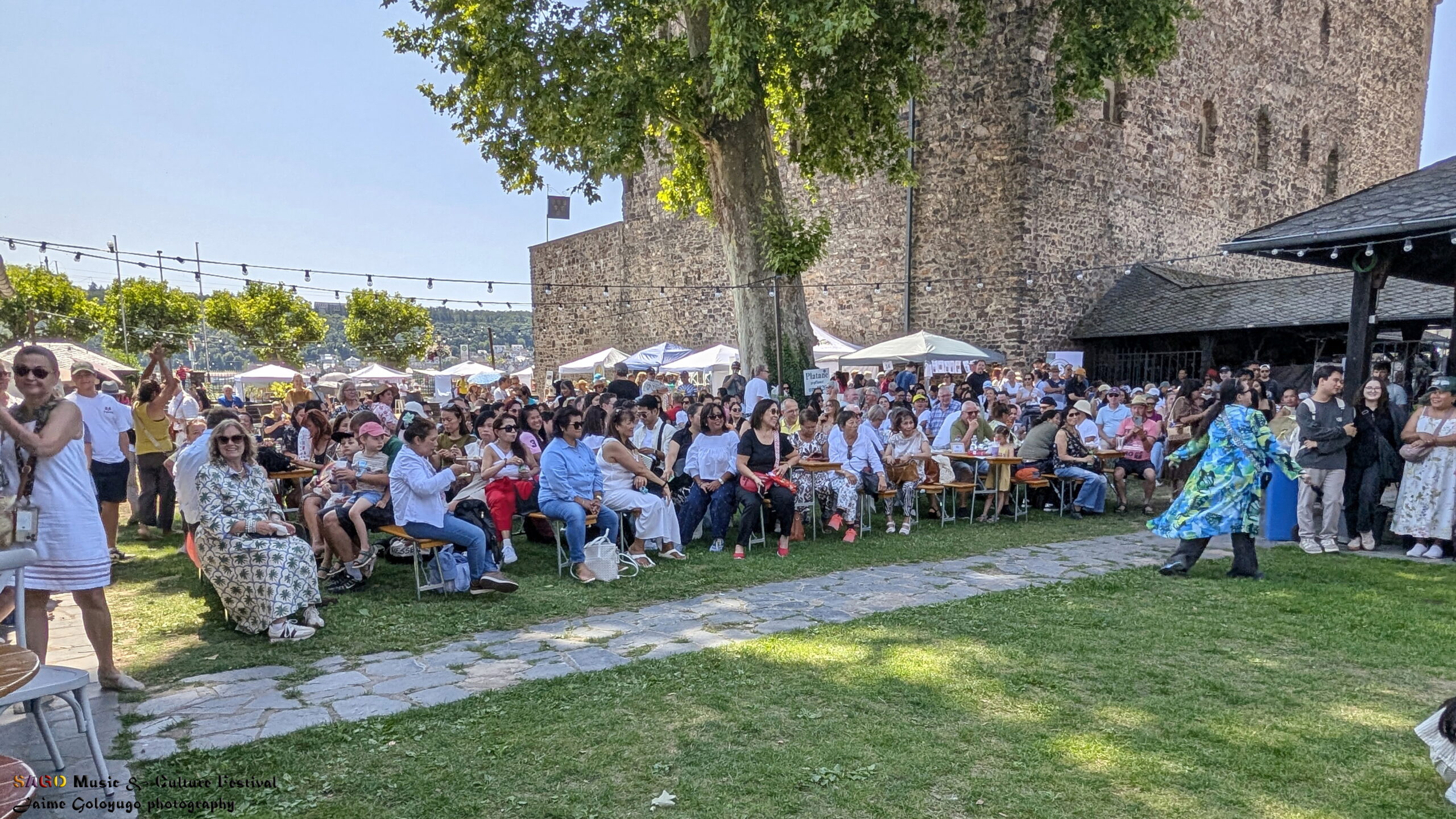
They came from Heidelberg, Bavaria, Aachen, Stuttgart, Würzburg, Bonn, Düsseldorf, Köln, Nürnberg, Ostfriesland, Frankfurt and Wiesbaden, as well as many other places we never had the chance to record.
Visitors joined us from beyond Germany too, including guests from Texas, USA, Kosovo, Spain, the United Kingdom, Denmark and Sweden.
Tour buses arrived. Tourists from Rhine cruise ships discovered the celebration. Some visitors had planned their journey specifically for SAGO; others were simply passing by, heard the music, saw the crowd and decided to stay.
Throughout the day, an estimated 2,500 guests became part of the first SAGO Music & Culture Festival.
Different nationalities. Different languages. Different backgrounds.

One festival. One Rhine. One celebration.
A Ceremony That Marked the Beginning
The official opening ceremony gave the day an even deeper significance.
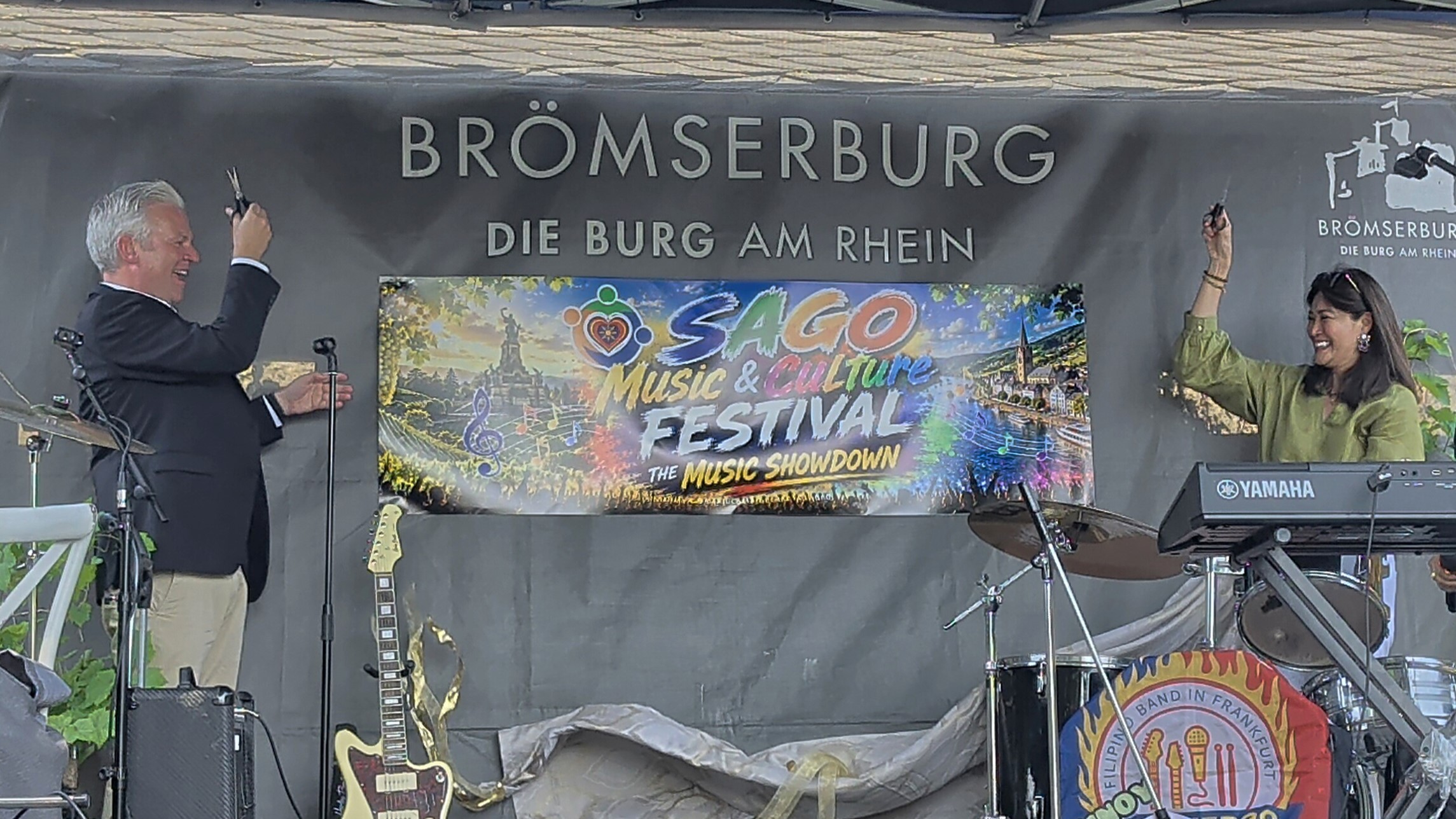
We were honored to receive a warm welcome from the Mayor of Rüdesheim am Rhein, Bürgermeister Dirk Stuckert, whose presence reflected the city's support for a celebration bringing Filipino, German and multicultural communities together in the heart of the Rheingau.
Our Guest of Honor, Consul General Marie Yvette Banzon Abalos of the Philippine Consulate General in Frankfurt, delivered an inspirational message to the community, recognizing the importance of culture, connection and the contribution of Filipinos to the diverse society we now call home.
Then came one of the moments that will forever belong to SAGO's story.
Mayor Dirk Stuckert and Consul General Marie Yvette Banzon Abalos joined us in unveiling the official Festival Artwork, ceremonially opening the first SAGO Music & Culture Festival in Rüdesheim am Rhein.
For the audience, it may have been one beautiful moment in the program.
For those of us behind the festival, it meant much more.
Behind that unveiling were months of conversations, meetings and revised plans. There were layouts, spreadsheets, phone calls, sleepless nights, last-minute solutions and people volunteering their time. There were sponsors willing to believe in something new and an organizational team determined to keep going even when the workload became overwhelming.
For months, the festival had existed in our minds, on our screens and inside our documents.
And suddenly, it was standing before us.
With the Mayor of Rüdesheim and the Philippine Consul General helping unveil the Festival Artwork, the communities at the heart of this celebration were symbolically represented side by side.
Filipino and German. Local and international. Tradition and a new beginning.
That was when it truly sank in.
We were no longer preparing for the festival.
The festival had begun.
A Filipino Connection Where We Least Expected It
Another touching moment came through our partnership with Bernhard and Vera Jung of Brömserburg am Rhein.
Herr Jung shared something that gave the partnership an unexpectedly personal dimension: his mother is Filipina.
He spoke about growing up surrounded by Filipino traditions, his affection for Filipinos and, of course, his love for Filipino food.
Suddenly, our relationship with the venue felt like more than a practical partnership. There was already a cultural connection there.
And hearing that SAGO would be welcome again for SMCF 2027 gave us another reason to look beyond our first festival and imagine what this celebration could become in the years ahead.
The MUSIC Showdown — A Stage Without Competition
One of the highlights of SMCF 2026 was something we proudly called The MUSIC Showdown.
The word showdown might suggest a competition — someone winning, someone losing, one performer proving they are better than another.
But that was never its purpose.
There were no losers on this stage. Every participant who stepped onto it was already a winner.
The MUSIC Showdown was a celebration of talent: an opportunity for artists to bring out the best in themselves and share it with an audience.
Some sang. Some danced. Some brought traditional culture to life. Others brought contemporary music, live-band energy and modern performances.
Instead of competing against one another, our artists collaborated, supported one another and complemented each other's talents.
It was never about asking, "Who is the best?"
It was about showing what can happen when different talents share one stage.
And behind every performance were hours of preparation that the audience did not see.
There were rehearsals, coordination meetings, program adjustments and sound checks. Performers made room in their personal schedules and, in some cases, travelled considerable distances to prepare for a performance that might last only a few minutes.
On July 25, many arrived long before the audience for sound checks, stage preparation and final coordination.
As Festival & Project Head, I want to say this directly to our artists:
We saw your effort.
We saw the time you gave to rehearsals. We saw your willingness to attend meetings. We saw you arrive early for sound checks. We saw the preparation behind those few precious minutes the audience eventually witnessed onstage.
And we deeply appreciate it.
Our heartfelt gratitude goes to Nurse Aki, Liam Bravo, Jamie Allison Chua, Jason Chua and Family Band, Lita Serato, Speed Limit, Tony Lozanes, Carlo Cabato, FGAA e.V. Dancers, Helping Hands e.V. Dancers, Perlas ng Silangan e.V., Annupama Sasankan, KSLP, 7th Element, Musikeros in Frankfurt, Kate Juaneza and Marlyn Mühlen, and everyone who worked with them behind the scenes.
Every voice, instrument, movement and cultural presentation added another piece to the story we wanted this festival to tell.
SAGO Music & Culture Festival was never created to determine who shines brightest.
It was created to provide a place where everyone could shine — together.
Different artists. Different talents. Different cultures. One stage.
Not competing.
Collaborating. Celebrating. Complementing one another.
Community Made the Festival Possible
A festival carrying a message of community cannot be built without community.
Our deepest appreciation goes to our community partners:
This festival was never meant to say:
"Look what SAGO can do."
We wanted it to say:
"Look what we can build when communities work together."
The Flavors and Faces of the Festival
Culture is not only something we watch onstage.
Sometimes culture arrives on a plate. Sometimes it is handmade. Sometimes it appears in a product, a book, a conversation or a small business owner proudly introducing what they do.
Our vendors and exhibitors gave the festival another dimension:
You weren't simply operating stalls.
You were part of the festival experience.
Thank you for taking a chance on a first-time event and becoming part of its story.
To Those Who Believed Before They Saw the Result
Sponsors do something especially meaningful for a first-time festival.
They believe before there is proof.
Our major sponsor, Streamlining Ventures, supported the event through event planning and organization, social media marketing, layouts, graphics and design.
Our Grand Raffle Sponsor, Flypino Travel GmbH, provided a round-trip Philippines–Germany airfare ticket.
Our Cultural Sponsor, Lois Grau Money Remittance Expert, provided financial sponsorship and support, while M. Weisenburger Cosmetics also contributed financial support as a donor.
To our raffle consolation sponsors — You Had Me at Halo Halo, Bong and Elena Cachuela, Eufemia Santoro, Pilipino Business Balikbayan Cargo, Filipino Taste, Noble Life, Lois Grau and Eric Manalo — thank you.
And to our food sponsors — Shake, Waffle and More, Mercedes Kakanin, Europhil e.V., Filipino Taste, Penoria's, Pilipino Business and Besfren's Treat Food — our sincere appreciation.
Every contribution, whether large or small, helped complete the festival.
The People Who Made Sure the Story Was Seen
An event may last one day.
Its story can last much longer.
That is why media coverage and documentation matter.
TTPM ACT Media, our Official Media Partner, had been part of the journey from Day One — amplifying our advocacy and calls for support, vendors, performers, sponsors and participants long before July 25 arrived.
Jaime Goloyugo Photography captured moments that otherwise would have disappeared in seconds.
Talk Alley and Filipinos in Germany helped amplify the story of SMCF through features, interviews and online coverage.
We are equally grateful for the coverage and interest from Wiesbadener Kurier, Rheingau Echo and Aimee Hilger of ABS-CBN News Europe, helping the story reach audiences beyond the festival grounds.
Our appreciation also goes to photographer Walter von Blohn, and to the vloggers, photographers and content creators who spent their own time recording, photographing, editing and sharing the festival.
You gave us something priceless:
memories we can return to.
And Then There Were the Volunteers
There is one group I want to acknowledge with particular emotion.
The volunteers.
Because volunteering means giving something that can never be returned:
your time.
To Ronald Sara, Kristie Arra Sacay, April Arcolas, Joe Maniaol, Nelly Gräff, Ingo Hauernherm, Khimme Malasaga, Jomar Lopez, Melinda Haas, Mildred Alex, Rochel Heuser, Gretchen Gipp, Zeny Klaedtke, Maria Era Scharf, Ofelia Kirst, Julie Dela Cruz, Marie Kris Javier, Yamini Wijesinghe, Connie Birrenbach, Susan Robles, Ken Ebihara, Alexandra Quimilat and Gian Raquion:
Please know this.
When people remember the music, you helped make it possible.
When they remember a clean, organized and welcoming festival, you helped make it possible.
When something needed carrying, fixing, checking, cleaning, guiding or solving, someone among you was there.
Some of the most important people at a festival are those whose names the audience may never hear announced from the stage.
So here, we say those names.
Because this history belongs to you too.
From Where I Stood
I have hosted events before. I have stood behind microphones. I have organized projects.
But being Festival & Project Head of SMCF allowed me to see something different.
I saw what people are capable of when they decide that something matters enough to work for.
I saw stress and exhaustion. I saw misunderstandings and problems that required immediate solutions. I saw people running from one responsibility to another and doing jobs that had never been written beside their names.
I saw the pressure behind the smiles.
And then I saw approximately 2,500 people become part of something that, not so long before, had existed only as an idea.
That feeling is difficult to put into words.
Because the audience saw a festival.
We saw months of our lives standing in front of us.
We Made History — Together
The SAGO Music & Culture Festival 2026 was not perfect.
No first festival is.
But perhaps history is not made by waiting until everything is perfect.
Perhaps it begins when people are brave enough to attempt something they have never done before.
On July 25, 2026, a Filipino-led organization in the Rheingau brought Filipinos, Germans and multicultural communities together in an open-air celebration beside the Rhine.
People travelled hundreds of kilometers.
International visitors joined us. Local residents came. Tourists stopped.
Artists performed. Businesses participated. Organizations collaborated. Sponsors believed. Volunteers served. Media documented.
And thousands celebrated together.
It happened because many hands carried one vision.
So when we say:
"SAGO made history,"
we do not mean only the name written on the banner.
- SAGO that day was the volunteer carrying equipment.
- It was the performer waiting backstage.
- It was the vendor preparing food.
- It was the sponsor who said yes.
- It was the first-aid team watching over the crowd.
- It was the photographer behind the camera.
- It was the community organization standing beside us.
- It was the guest who travelled hours to be there.
- It was the person who shared our poster when we were still asking people to believe in us.
You were SAGO that day.
And therefore,
you are part of this history.
To Everyone Who Was There — Thank You
To BFT, thank you for having the vision and daring to believe it could become something real.
To our organizational team, thank you for carrying responsibilities most people will never fully see.
To our community partners, thank you for standing with us.
To Brömserburg am Rhein and the Jung family, thank you for opening your venue and your hearts to this festival.
To Mayor Dirk Stuckert, Consul General Marie Yvette Banzon Abalos, our distinguished guests and supporters, thank you for honoring our first festival with your presence.
To every performer, vendor, exhibitor, sponsor, media partner, photographer, vlogger, volunteer and supporter:
Thank you for giving a piece of yourself to July 25, 2026.
And to the approximately 2,500 people who came from near and far:
Thank you for turning our plans into a festival.
Thank you for dancing, eating, singing, staying and celebrating with us.
Most of all, thank you for believing that Filipino culture deserves to be seen, heard and celebrated alongside the many cultures that call Germany home.
Years from now, SAGO Music & Culture Festival may be bigger.
There may be bigger stages. More performers. More vendors. More visitors. More days. More cities and countries represented.
But there is something no future festival can ever replace.
There will only ever be one first.
And for the SAGO Music & Culture Festival,
we were there.